
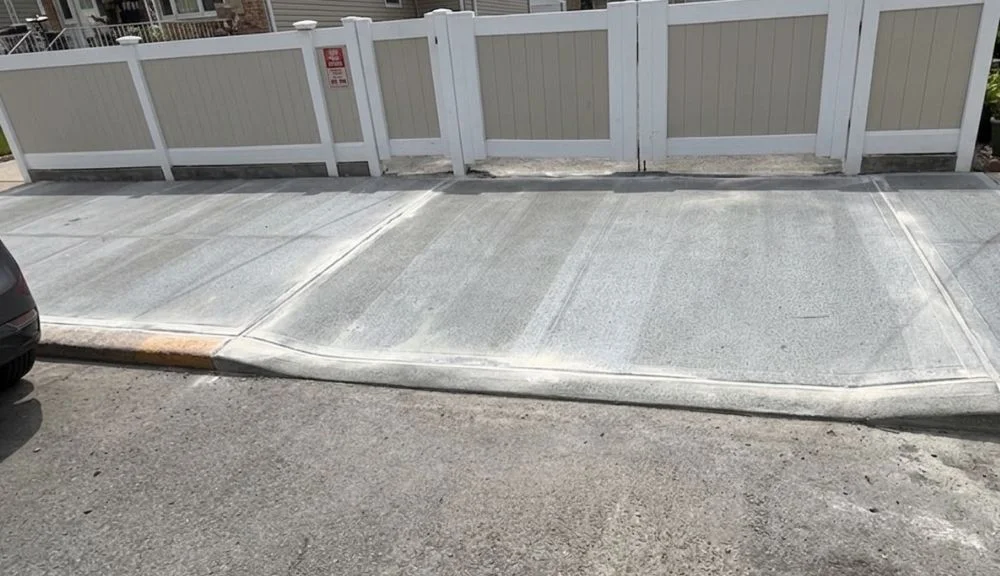
Project: Residential Sidewalk Repair in Jamaica, Queens
Not every sidewalk violation stems from a single dramatic cause. At 177-14 136th Ave in Springfield Gardens, Queens, the damage told a slower, more familiar story: years of daily foot traffic combined with constant vehicular movement across the driveway apron had gradually worn down, cracked, and displaced slab after slab until the deterioration stretched across the entire frontage. By the time the property owner reached out to Eden Sidewalk Contractors NYC, the situation had grown urgent. Roughly half of the city's 75-day compliance window had already elapsed, leaving a narrow runway to inspect, permit, and repair 16 damaged slabs, all while working around an active driveway and a curb cut that would need to be fully reconstructed to meet DOT specifications.
Key Obstacles We Had to Overcome
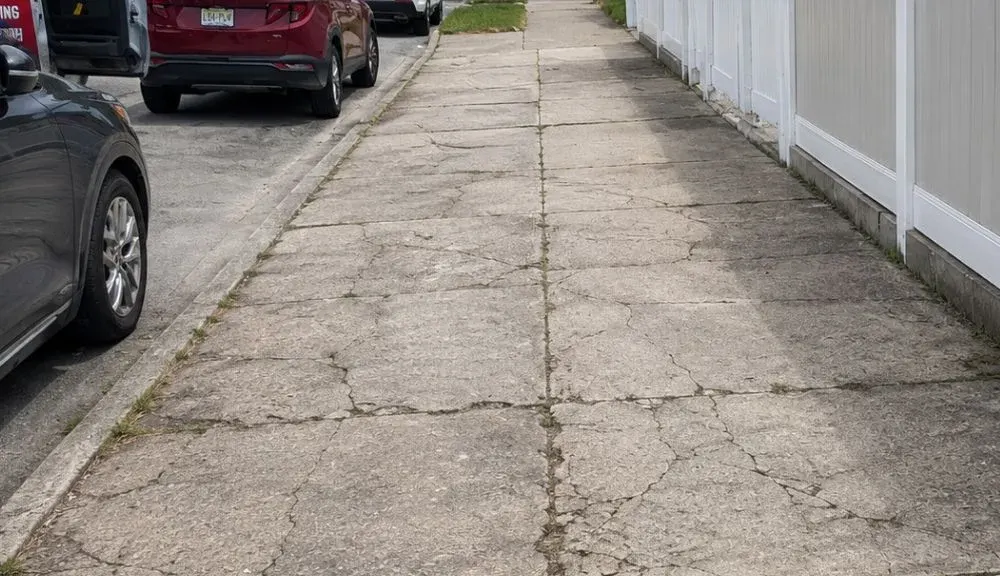
- Widespread Wear-Based Damage: Unlike root intrusion or a single point of failure, the cracking here had developed gradually across the full frontage, worn down by the combined weight and friction of daily pedestrian and vehicle traffic crossing the driveway apron.
- A Shrinking Compliance Window: With roughly half of the 75-day clock already gone by the time Eden was contacted, there was significantly less room for delay in permitting, scheduling, or execution.
- Curb Cut Complexity: Because the driveway crossing required a full curb cut reconstruction, the repair needed premium, high-strength concrete along with a deeper sub-base, approximately 7 inches, as recommended by DOT for areas that carry regular vehicle loads.
- Larger Repair Footprint: At 16 slabs and roughly 400 square feet, this was a significantly larger repair than a typical isolated violation, requiring more coordination across materials, labor, and permitting.
Given the compressed timeline, Eden's team knew the project needed to move efficiently from day one, with permitting and material planning happening in parallel rather than in sequence.
How We Got It Done with Half the Deadline Already Gone
Step 1: Rapid Inspection & Estimate (Day 0 – Day 1)
Given how much of the compliance window had already passed, speed was the priority from the first phone call. Our team reviewed the extent of the sidewalk damage, including the condition of the curb cut and driveway apron, and returned a detailed estimate within 24 hours. The property owner approved the scope digitally, and permit documentation began the same day to avoid losing any further time.
Step 2: Expedited Permit Filing & Scheduling (Day 2 – Day 11)
With the clock already running, we filed the sidewalk repair permit, the sidewalk closing permit with the NYC DOT, and the curb cut permit with the NYC DOB simultaneously rather than in stages. Because the driveway crossing required reconstruction, the curb cut permit needed specific design details confirming the use of high-strength concrete and a 7-inch sub-base to meet load-bearing standards for vehicular areas. Our team handled every filing directly, keeping the timeline as tight as possible while the property owner stayed informed at each step.
Step 3: Executed Code-Compliant Sidewalk & Curb Cut Replacement (Day 12 – Day 14)
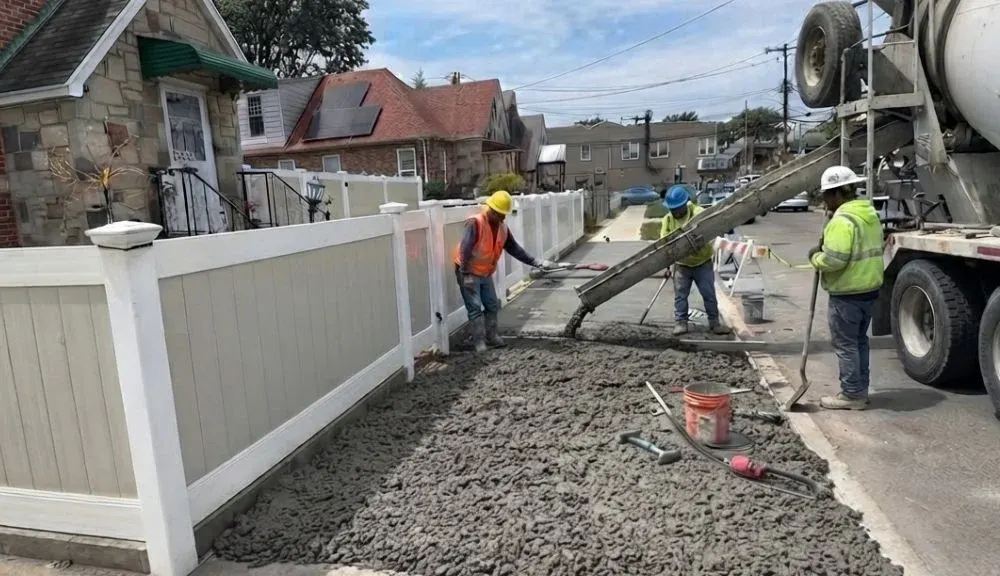
On the scheduled start date, the crew mobilized to remove all 16 damaged slabs across the full 400-square-foot frontage, including the deteriorated curb cut section. Given the vehicular load the driveway crossing needed to support, the team excavated to a full 7-inch sub-base depth as specified by DOT, rather than the standard depth used for pedestrian-only sections. Premium, high-strength 4500 PSI concrete was poured across the entire area and finished to match NYC DOT standards, with particular attention paid to the curb cut's slope and transition for safe vehicle access. Pedestrian safety barriers were maintained throughout, and the site was cleared and cleaned at the end of each work day. Despite the scale of the repair and the added complexity of the curb cut, the crew completed the physical work in three days.
Step 4: Final Inspection and Violation Dismissed by DOT (Day 15 – Day 45)
Once the new concrete had properly cured, our team coordinated the final DOT inspection on the owner's behalf. With the compressed timeline in mind, Eden prioritized scheduling the inspection as early as the curing process allowed. The repair passed on the first inspection, officially closing out the violation well before the 75-day deadline expired.
From Worn-Out to Brand New
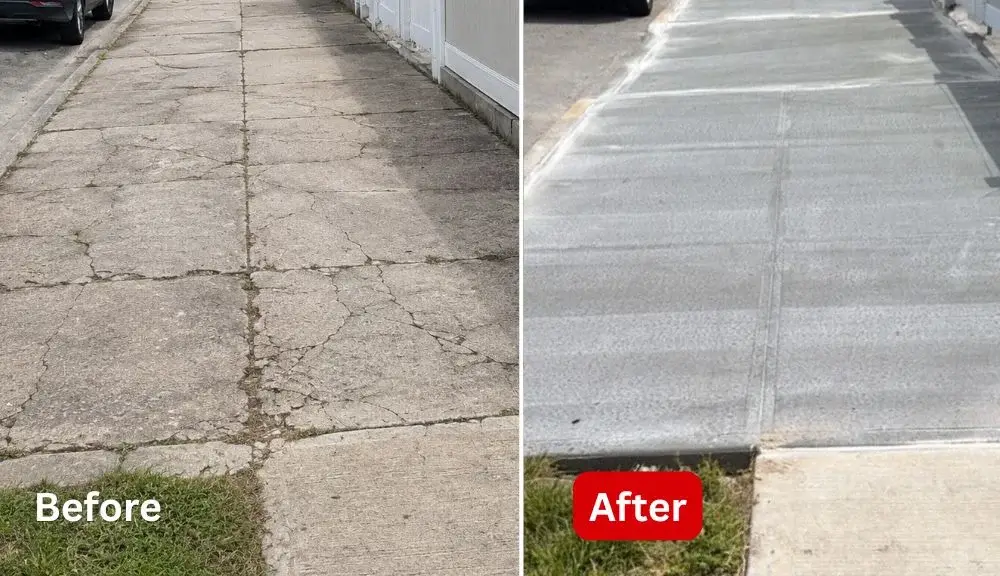
Before:
- 16 sidewalk slabs, roughly 400 square feet, were cracked and worn down by years of combined foot and vehicle traffic.
- An active NYC DOT violation was already halfway through its compliance window when the owner reached out.
- The deteriorated curb cut created an uneven, potentially hazardous transition for vehicles entering and exiting the driveway.
- The property owner faced pressure to move quickly across permitting and construction with limited time to spare.
- The extensive damage affected the entire frontage rather than an isolated section.
After:
- A full 400 square feet of smooth, level, DOT-compliant concrete now spans the property's frontage.
- A newly reconstructed curb cut, built with high-strength concrete and a full 7-inch sub-base, is now equipped to handle daily vehicle loads.
- The DOT violation was resolved with time to spare before the compliance deadline.
- A safer, more durable walking and driving surface for residents, visitors, and daily passersby.
- The entire process, from first phone call to final inspection, was compressed into a matter of weeks without cutting corners on materials or specifications.
The Difference We Made
This project delivered exactly what a time-pressured property owner needed: a fast, thorough resolution that didn't sacrifice quality for speed. By filing all three permits in parallel and scheduling construction as soon as approvals came through, Eden closed out a 400-square-foot violation with meaningful time to spare on the compliance clock, protecting the owner from fines, city-performed repairs, or a lien on the property.
The decision to build the curb cut to full vehicular specifications, premium concrete, and a 7-inch sub-base means the new driveway crossing is built to handle daily wear far better than the original installation, reducing the likelihood of similar damage resurfacing in the years ahead. For a property that depends on regular driveway access, that durability translates directly into fewer future repairs and less disruption.
Beyond the physical work, the property owner benefited from a process that required minimal hands-on involvement.
The Owner’s Perspective
The property owner shared the following after the project's completion:
"We didn't realize how much time had already passed on the violation clock until we started looking into it, so we were honestly worried we wouldn't make the deadline. Eden moved fast and got all three permits filed right away. The crew redid our entire sidewalk and driveway entrance in three days. Everything looks solid, and knowing the violation is cleared with time to spare is a huge relief."
Final Thoughts
The sidewalk and curb cut replacement at 177-14 136th Ave. demonstrates our ability to deliver under real-time pressure without compromising on materials or code compliance. By combining rapid, parallel permit filing with a properly engineered curb cut reconstruction, the team resolved a violation for a Queens property owner well ahead of a fast-closing deadline.